

Frontline
Impacts of FLOW on Celtic Sea Ocean Fronts and Biodiversity
Lead Principal Investigator: Stephen Votier, Heriot-Watt University
Overview
FLOW has the potential to accelerate global net zero targets but, as it ventures into deeper, seasonally stratified shelf seas, the associated non-static infrastructure could have profound consequences for ocean physics, key ecosystem drivers and extend to top predators and fisheries via impacts on ocean fronts. Ocean fronts are persistent, highly productive, dynamic boundaries between stratified and mixed waters which create critically important marine biodiversity hotspots, valuable fishing grounds and are fundamental for the climate system.
Our vision is to explore potential FLOW infrastructure impacts on shelf sea ecosystem dynamics in the Celtic Sea, from ocean physics to phytoplankton, zooplankton, forage fish, top predators, and fisheries.

Image credit: [Insert here]

Develop a mechanistic understanding of how FLOW-driven and naturally driven variation in stratification and frontal activity in the Celtic Sea influence water column physics, chemistry, and trophic interactions, using in-situ autonomous sampling in combination with high-resolution satellite remote sensing.
Objectives

Quantify FLOW effects on frontal strength, timing, and persistence on Celtic Sea marine predator communities — linking spatial and temporal patterns in predator distribution, abundance, and fine-scale behaviour.

Quantify the potential direct effects of FLOW infrastructure — distinct from those of fixed-position wind farms — on seabirds in terms of displacement, barrier effects, and collision risk above and below water, integrating digital aerial surveys and tracking data.
Quantify how FLOW-driven changes to ocean fronts and key ecosystem drivers reshape fish distributions and gear-specific fisheries, and assess the associated social and economic implications.
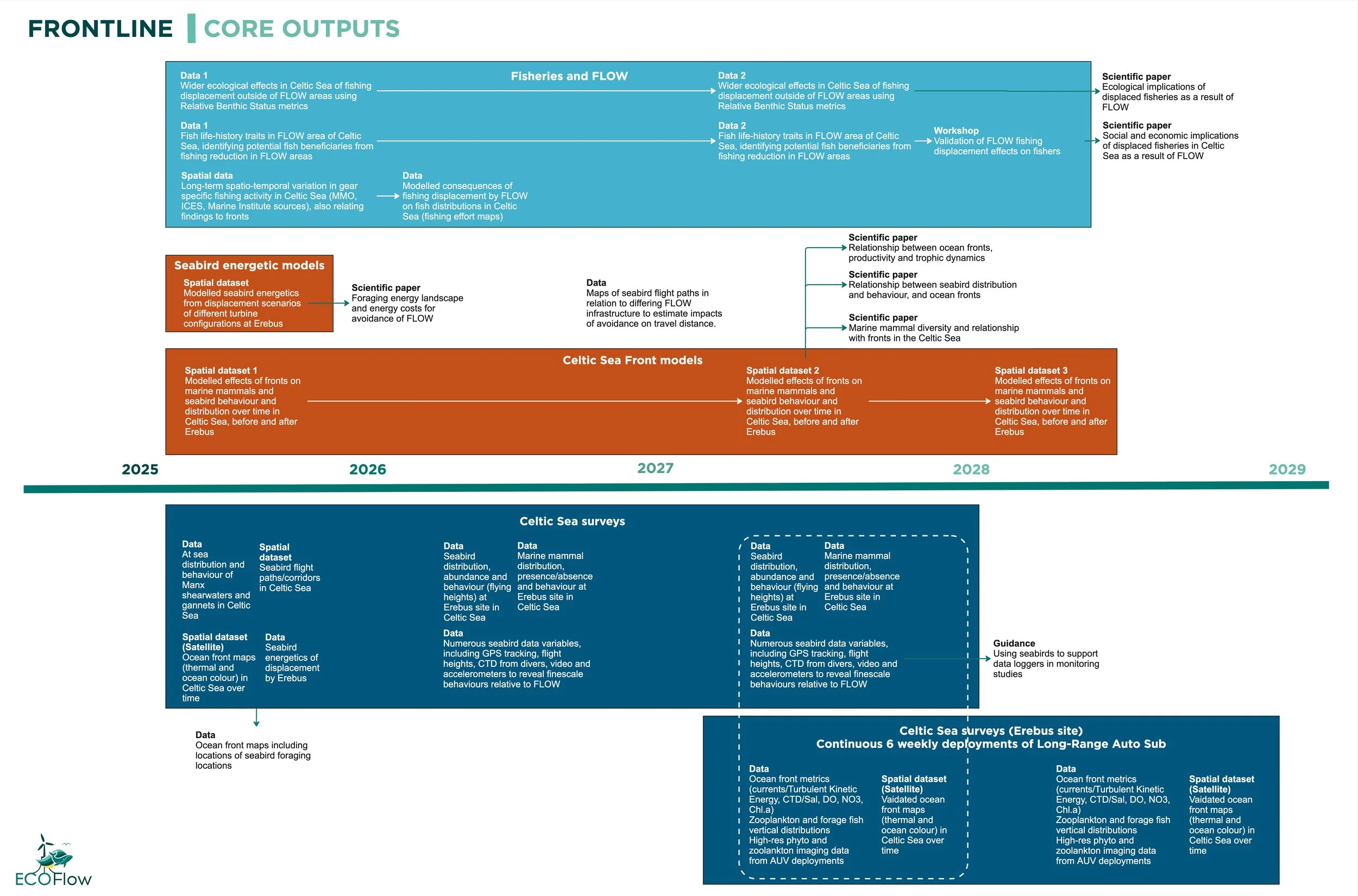

FRONTLINE will deliver new ecosystem-scale insights on FLOW development and provide practical guidance to mitigate FLOW impacts and promote nature recovery. We will establish repeatable autonomous underwater and satellite-derived monitoring approaches, inform strategic compensation, and evaluate ocean fronts as priority conservation areas. Decision-ready outputs—including dynamic front maps and associated key ecosystem drivers, wildlife movement corridors, key predator foraging habitats and fishing hotspots —will serve as risk layers for marine spatial planning, FLOW site selection and coexistence with fisheries and other stakeholders while informing climate-change adaptation.
Impact
Frontline Team
Heriot-Watt University
Plymouth Marine Laboratory
University of Plymouth
University of Oxford
HiDef Aerial Surveying
University of Liverpool
Frontline Partners
Blue Gem Wind
Natural England
Natural Resources Wales
Welsh Fisherman’s Association
Celtic Sea Power
Marine Management Organisation
Flotation Energy
Department for Environment, Food and Rural Affairs
